Wednesday, July 21, 2010

Finishing out the trip


I'm actually writing this post after I returned here to Florida. We were so busy the last five days I'll have to exercise brevity so this post doesn't last forever.


Last Tuesday: Our first lesson of the day was about the unique leadership techniques used by Chung Ju-yung (nickname Asan), the founder of Hyundai. After the Korean War, this man and the founder of Samsung basically rebuilt the entire country. Asan traveled to Germany to figure out how to build the roads for the country. After his construction company prospered he said, A ship is basically an engine contained in a welded steel box. Our company builds power plants like this all the time. Why should we not be building ships? So with no experience in shipbuilding, this man founded the Hyundai shipyard and evolved it into the world's best one. His story is very inspiring if you are looking for a good biography to read.


Our second class that day was taekwondo! It was way fun to get our butts kicked by tiny Korean girls but the students made us feel good by having us break boards with our newly learned punches and kicks. They put on an amazing show with spinning kicks and jumpkicking boards over six people laying down which made me realize after the hour of lessons, I still had a ways to go yet. But it did spark and interest in doing is here in the USA!


Wednesday: Today was chock full of tours and stuff. We began by going to a tiny village which makes a specialized pottery called Onggi. The vessels (small as a cup to huge jars which can contain a good five adults standing up) are made of a special clay which allows oxygen to escape and creating the ideal conditions for fermenting the vast array of foods Korea indulges in. Kimchi is served at every meal, no exceptions, and is a spiced fermented cabbage which is put in one of these jars and buried in the ground to "cook". We had a meal here and progressed to the whale museum in Ulsan. It was a tribute to whales but also described the extensive, yet now banned, whaling industry in Ulsan. It used to be huge here but now the only whales that can be eaten are ones that are accidentally caught in fishing nets, which is not that often. Next door to the whale museum was a fish and dolphin aquarium. When the dolphins were fed, they did each performed and in line with Korean custom, they bowed to the audience when they finished. Next stop was a traditional Korean market which turned out to be much different than what I was expecting. Think old buildings, crowded streets with pushcarts and this is the opposite of what we visited. The market was a series of themed warehouses (dead seafood, fruit, veggies, live seafood) which you could walk inbetween and was absolutely packed with products sold by individuals or a family. We ended up in the live seafood area to have a dinner of the freshest sashimi (raw fish) any of us had ever had. We also tried whale meat (which I feel really guilty about but our guides ordered it) which was really greasy but actually not bad. The sashimi included different local fish and octopus which is called nakji. Other dishes included cooked eel with scallops and boiled octopus. This was by far my favorite meal in Korea. That night we road the ferris wheel located in downtown Ulsan and visited a karaoke joint (locally called the singing room) and introduced our fellow Korean students to some classic American music.

Thursday: Our first class this day was about the social characteristics of Korea. Some interesting facts are that 90% of high school grads attend a 2 or 4 year college. Also, among the G20 nations, it has the lowest incident of teen pregnancy, less than 1%.

Saturday: Our flight from Ulsan to Seoul and from Seoul to Chicago were scheduled too close together so we took a 5.5 hour bus ride across the entire country to get to Incheon airport early. This consisted of a lot of sleeping but was like riding first class in a realllly slow airplane! The rest stops were pretty awesome and had massage chairs to relieve some of the stress from traveling! I grabbed some kimbap (kind of like sushi rolls but cooked meet or veggies instead of raw fish) for lunch and slept again until we reached the airport. We all enjoyed some Americanized food there and I indulged in a hot dog but, as usual, they were still a little bit off. My hot dog had avocado on it. Most of us were just about ready to go home, and once we all were on the plane, it was a comforting feeling knowing that in 12 hours, we would be back in the US after an amazing trip to Korea.

Monday, July 12, 2010

Ten more days....


It's hard to believe it has been a whole ten days since I last posted on here. Time is flying by now and we leave in five short days. But here is a recap of what's been up. Last weekend we went to Busan (3.5 million strong) and visited the coastline of Haeundae beach which was nice but as usual it was overcast and foggy so it was not a good beach day. A boardwalk went up onto the craggy coastline and we followed it around to a building constructed a few years back for the leaders of the Southeast Asian countries to meet and discuss trading policy. It was interesting to see but we were shuffled back on the bus for another journey up a mountain an hour away. Upon reaching the top we followed a nature trail through the pine and bamboo forest and finally reached another Buddhist temple. We were all exhausted from the journey up the mountain in 90 degrees and 130% humidity so our visit was not as extensive as the week before.

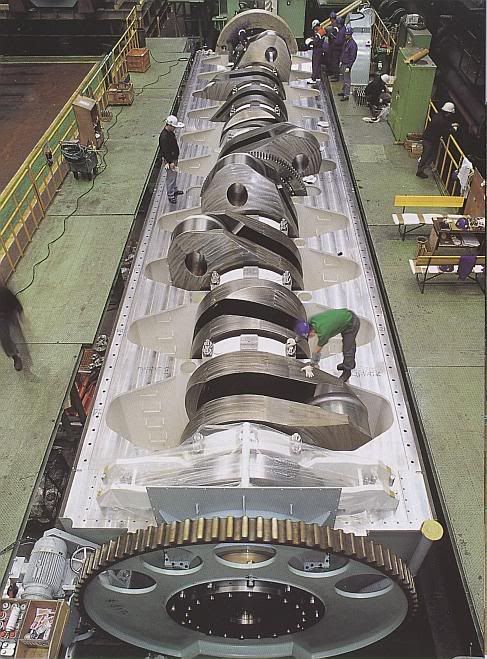
Monday at the shipyard marked the beginning of our visit to the two and four stroke engine construction division of the yard. Hyundai Heavy Industries makes their own engines for their ships and also sells them to other shipyard and anyone who needs an enormous freaking engine. And big they were. The key word of the week was 'scale' because everything we saw exceeded the scales we were used too. http://img.directindustry.com/images_di/photo-g/two-stroke-marine-diesel-engine-363991.jpg These engines are larger than my house, typically three stories tall and weighing well over 1000 metric tonnes. Each cylinder (of which they have 6-12) was about 3 feet wide and over 8 feet tall and the engines are pumping out almost 100,000 horsepower.

The most expensive and complected part of the engine to construct is the crankshaft shown here http://i171.photobucket.com/albums/u312/1979bd/diesel/crank.jpg. The explosions in each cylinder push on the "crank throw", which the guy is touching in the foreground, which turns the propeller shaft. We watched these forged from a raw, red hot, 300 tonne chunk of steel by machines which look like they could take over the world. After they forge the rough shape of the crank throw, they use dozens of building tall lathes, mills, and boring machines costing tens of millions of dollars a piece to mill the rough crank throw to the precision of the thickness of a human hair. Heavy Industries indeed. Oh yeah, and they are slotted to make over 350 of these huge engines this year. Oh yeah, and next door in their four stroke engine (smaller, just around a mere 40,000 hp) department, they are going to make over 1,000 engines this year. This company is not just well oiled, it's essentially perfect. Later in the week we went to the facilities where they take the machined parts and put them together and finally test the engines. I also had the opportunity to turn on one of the 1,500 hp four stroke engines on myself! For the beastly size of the engine, all it took was pushing a button on the side of it, but as soon as I taped it, the machine roared to life with such ferocity, it really made me step back!

On Friday we concluded our time at HHI and moved out of the posh workers dorms and made our way to the student dorms at Ulsan University, toured their Naval Architecture and Ocean Engineering department and lab facilities and hunkered down for the night with plans of visiting Busan the next day.

One of the Korean students, Kim; Kurt from Michigan; and I all caught a train to Busan on Saturday and took the subway into the shopping shopping district of the 3.5 million strong city. We were on a quest for Korean clothes, in particular shirts with poorly translated English (Konglish locally), Korean clothes, and imitation designer stuff (in case you are looking for Burberry knock off stuff here, they don't exist here). The shopping district was really interesting in that the main roads had huge sidewalks with top designer stores including weird ones (an entire store for Levi's underwear and a store of all Jeep clothing) and all the side streets connecting the large ones, were car free and filled on the sides by Korean clothing boutiques and in the middle was an endless sea of imitation stuff, Disney clothes, and Korean street food. We planned on staying for the night to catch a glimpse of the night scene but a veritable monsoon began pouring down and washed away the people from the streets and our desire to go a bar soaking wet. Apparently Koreans hate being in the rain because the packed streets cleared fast and our guide leaped to safety under every available awning during our trek back to the subway station.

The rainstorm which began in Busan, followed us back to Ulsan and continued nonstop for over 30 hours preventing much activity at all on Sunday. It is the rainy season here now and this weather is typical for the month of July. Today we began our classes here at the University and we learned about the history of Korean shipbuilding and why they rule at it now, and we took another class of traditional Korean folk music. It is called Samulnori and is played with the following four percussion instruments: the kwaengwari, a small gong of sorts which is the voice and leader of the group; the jing, which is essentially a gong; the buk, which is a big drum; and the janggu, which is a two sided drum with two different tones played with two different types of drum sticks. A Samulnori group has one kwaengwari, one jing, and maybe a dozen of the other two drums. The group played the beat the Michigan students were supposed to learn and to be honest, I was not that impressed with the quality of the music. That is, until we got up there and tried playing the song for ourselves. We struggled through a rendition of the song they played for us for awhile and eventually we listened to them play again, at which time they really opened up. http://www.youtube.com/watch?v=XziGQswTcGY&feature=related.

More updates soon. And in the wise words of Konglish, "Goes out Vega, fries away safe and sound".

Thursday, July 1, 2010

Soccer and the Shipyard

Soccer fever here has since declined after Korea was knocked out of the World Cup Saturday night. But man what a party it was! We were told that Hyundai was hosting people in their gymnasium to watch the game on a big screen. I expected a high school gym with the game projected on a screen but as soon as we walked into the stadium, we all caught soccer fever. Easily over 3,000 people were in the bowl watching the game on three screens with cameras catching reaction shots from the crowd! They had their own halftime show, cheerleaders, drummers leading chants, you name it. The drummers would lead us in two main chants, the first being "Dae han min guk!" (bum bum, ba bum bum!) "Dae han min guk!" (bum bum, ba bum bum!) "Dae han min guk!" (bum bum, ba bum bum!) (Repeat until hoarse.) "Dae han min guk" is the formal name of Korea. The other was "Oh, pil seung Ko-re-a, oh, pil seung Ko-re-a, oh, pil seung Ko-re-a, o- ho-o-ho-o HEY HEY HEY!". Our Korean pals told us it means "certain victory" in Korean. The atmosphere was electrifying and we really were all hoarse by the end of the night.

Recovering Sunday, we checked out Ulsan University, where we will spend our last week taking classes about the culture of Korea, ate duck stir fry, and visited a bar named "Cow 9", mainly because of the name and the novelty of going to a southwestern bar in the middle of Korea.

This week at Hyundai was our first in the actual shipyard and each day we have visited a different department in charge of a different part of the ship construction process. The massive 1000+ foot ships built here are steel and begin as 9 foot by 24 foot plates of 3/8"-1" thick steel. The first day we visited the factory in charge of joining these pieces together into "blocks". A block can be likened to the pieces created by dicing a tomato or onion into 100 pieces. Each hunk is a block and a ship is constructed by building each block separately and welding them together in a dock that will eventually get flooded so the boat can float away. The second day we visited the docks where the blocks were being joined and were given a behind the scenes tour of the goliath orange gantry cranes which drop the blocks into place. Being 350 feet in the air on a moving machine made my heart skip a beat when we stepped out of the guts of the crane. Wednesday we examined the process of how the deckhouse of a ship is constructed (the big tower with windows on it that sticks up above the body of a vessel) and we toured a few completed ships ready to be delivered. Today we learned more about how a shipyard of this magnitude is run which consisted of visits to the "control tower" of the yard and lessons on how they construct with such precising and minimal reworking of steel to make the vessel fit together.

On a side note, they serve Korean style Raman noodles here as a main course. I think I've died and gone to heaven.

Saturday, June 26, 2010

Photos Online

Check out all of my pictures from the trip here:

http://picasaweb.google.com/burtonxc/Korea?authkey=Gv1sRgCJispriPmJSzKw&feat=directlink

One week at Hyundai + a cultural tour


Today marks the first week spent in Korea interning at Hyundai Heavy Industries (HHI). The experience has already proved invaluable as we really have an insiders look at how the best shipyard in the world operates. In America, research and development is rarely, if ever (I think) done at shipyards. It is something that a different division of a company does elsewhere, or in the case of the Navy, research is done in many different places around the country. At HHI, however, they are doing research and development in all areas of shipbuilding from painting to welding, ship hull design, propulsion and engines, vibration and noise control, propeller design, and structures, etc. In fact, we spent each day this week, 8am-5pm in their research facilities, attending lectures on what each department does and learning why their work is cutting edge. We witnessed tow tank tests in their state of the art facility (state of the art is a relative term. It was built in 1984 but is really new when compared to University of Michigan's tow tank which was built eighty years prior in 1904), observed structural steel tests for their massive Liquid Natural Gas carriers, and participated in a competition within our group to analytically determine the load on a cylinder standing vertically in the water in waves. We validated our calculations by performing a model test in their 2D wave tank. This is similar situation to the wave loading that a SPAR oil rig experiences at sea. It should also be noted that this week was entirely spent inside research labs and we have not even scratched the surface of the actual shipyard!

Each evening we have returned to our dorms, exercised in the gym (table tennis is huge here and the gym has four tables), and walked to the local restaurants and bars to experience the culture here. Bar-wise, there are specific Western style bars where pocket billiards are the centerpiece and whereas the local style establishments include food as a major piece of the nightlife. We went to a place last night where we sat on the floor at a table which had a coal pit in the middle and we fried pork and ate it on lettuce with a variety of sauces. Soju is the popular alcoholic drink here and traditionally you may only be served by another person and the respectful method of pouring is with two hands.

On Saturday, we visited several mountain temple sites in the ancient capital city of Gyeongju. The main temple was finished in 774 and was destroyed by Japanese invaders in 1593. It was rebuilt after extensive research following the Korean War. After, we drove up a huge mountain into the clouds to visit the Seokguram grotto which contains what is regarded as the best Asian Buddhist work. The stone carving of Buddha is massive and is recessed in the mountain and surrounded with carvings of different gods and guardians. It was an awe inspiring experience to visit a place so in touch with nature and rich in history.

Tonight Korea plays in the World Cup and we are going with the three Korean students, who are participating in this internship with us, to the HHI gymnasium to watch the game with many many other people. America does not play until 3 am here so we are all going to be sporting red shirts to cheer on Korea.

An-nyong-hi ka-se-yo! (Goodbye for now!)

Wednesday, June 23, 2010

안녕하세요 - Hello!


Flat maps of the earth are some of the most deceptive things we take for granted. If you were to ask me the fastest path to get from Chicago to Seoul, I would get out a trusty straightedge and draw you a line from one city to the other. Thus it was to my great surprise when stepping onto the plane when the lcd screen in front of my seat displayed out route passing in a large arc through the ARCTIC CIRCLE! No joke! Due to the curvature of the Earth, the fastest route passed into Canada, over Alaska and the Bearing Sea, into the Arctic Circle, and back down over eastern Russia, Japan, and finally to Seoul. Cool to think about when you are flying up there.

So after 14 hours of rough sleep, we all woke up in Korea. We had skeptical ideas of the food due to one dish served on the plane requiring an instruction manual and a toothpaste tube of red pepper paste to eat. But the first thing when we stepped off the plane was how much cheaper food was! Sushi and a drink for lunch was just over 3 bucks (3,500 won). This was observed after dealing with the ticket counter which was in itself a culture shock. Although I have traveled to Mexico and dealt with a language barrier, taking several years of Spanish helped immensely with communication. This was the first time I walked up to someone and had no hope of communicating in the local tongue. All the stuff I learned from my phrase book left my brain and speaking in English had little visible effect. Once we all had our tickets for the next plane, we prepared to reach our ultimate destination of Ulsan.

We deplaned by a big ramp onto the tarmac and the first thing that stood out was the scenery which was clearly the inspiration for traditional oriental landscape artwork. Misty green mountains, rice paddies, and gardens we abound in the elevated landscape whereas all the valleys were packed to the brim with apartment buildings, city sprawl, and industry. Driving through the city, gardens pop into view amongst the buildings and when someone in a straw hat is tending the land, it looks like 500 sq. ft. of a countryside farm dropped in the middle of a city. There really is a certain harmony between technological advances and the environment in Ulsan. Part of that stems from the fact that the city did not exist 50 years ago. It was a small fishing town until after the Korean War, when 'Asan' Chung Ju-yung formed Hyundai. And it was not until 1973 when Hyundai Heavy Industries (HHI) was formed and the town of Ulsan began to be fostered by the rapidly expanding shipyard (HHI). Now, everywhere in the city you can see evidence of the shipyard. From Hyundai hotel to the 25,000 people who are work at HHI, it is impossible to go anywhere and not see people wearing their work jacket or pants. They are worn with pride here because it really is an honor to work for the best shipyard in the world. Unlike American shipyards, the workers do not put stickers on their hard hats or personalize their outfits. HHI workers are proud to wear their work uniform even outside of work to show off that they work for Hyundai. It is truely a different world over here.

Be sure to take off your shoes before entering this blog.

Friday, June 18, 2010

First Post

Waiting for my flight back to Fort Lauderdale in the rural and quiet Mobile, Alabama airport, I had the unsettling feeling dawn on me that South Korea is truly a world away from where I was. I began to think of exactly how far I was going to be traversing over the Earth this coming Sunday but the notion of going to the opposite side of Planet Earth was a tough one for me to grasp. Even my research on the net produced measurements whose meaning were lost in their size. From my home base of Ann Arbor, Michigan, I would be flying just shy of 6,800 miles. By comparison, the distance from Ann Arbor to the center of the earth is 6,400 miles. Effectively, the pure distance our group was going to be traveling was a few hundred miles more than the width of the earth. The distance of our trip now had meaning and was toying with the scale of planets.

I next wanted to comprehend how far around the globe we were going to be, relative to Ann Arbor. Using the powerful picture analysis program called Paint, it looked like we were traveling a 1/3rd of the way around the globe. Time wise, that will put us 13 hours ahead of the Mitten. When Michiganders are enjoying a summer evening, we will be eating breakfast and getting ready for another day in the Hyundai Heavy Industries shipyard. How weird.

Tomorrow, the day before our group meets in Chicago, is going to be the big prep day for traveling abroad. I need to open a National City bank account, buy a digital camera, pay bills for the next month, buy a piece of luggage, set up Skype on my computer, buy an adapter for the Korean power outlets, and get a massage. Or I might just put it off until Saturday morning, and go to the beach instead.

Also, note to self: REMEMBER TO BRING YOUR PASSPORT!