
It's hard to believe it has been a whole ten days since I last posted on here. Time is flying by now and we leave in five short days. But here is a recap of what's been up. Last weekend we went to Busan (3.5 million strong) and visited the coastline of Haeundae beach which was nice but as usual it was overcast and foggy so it was not a good beach day. A boardwalk went up onto the craggy coastline and we followed it around to a building constructed a few years back for the leaders of the Southeast Asian countries to meet and discuss trading policy. It was interesting to see but we were shuffled back on the bus for another journey up a mountain an hour away. Upon reaching the top we followed a nature trail through the pine and bamboo forest and finally reached another Buddhist temple. We were all exhausted from the journey up the mountain in 90 degrees and 130% humidity so our visit was not as extensive as the week before.
Monday at the shipyard marked the beginning of our visit to the two and four stroke engine construction division of the yard. Hyundai Heavy Industries makes their own engines for their ships and also sells them to other shipyard and anyone who needs an enormous freaking engine. And big they were. The key word of the week was 'scale' because everything we saw exceeded the scales we were used too. http://img.directindustry.com/images_di/photo-g/two-stroke-marine-diesel-engine-363991.jpg These engines are larger than my house, typically three stories tall and weighing well over 1000 metric tonnes. Each cylinder (of which they have 6-12) was about 3 feet wide and over 8 feet tall and the engines are pumping out almost 100,000 horsepower.
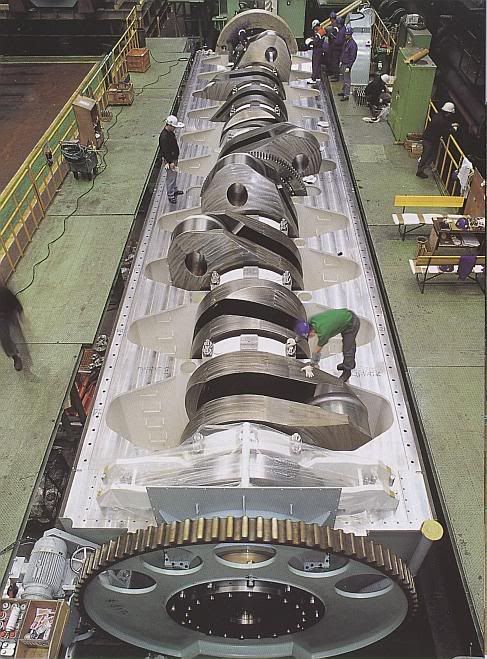
The most expensive and complected part of the engine to construct is the crankshaft shown here http://i171.photobucket.com/albums/u312/1979bd/diesel/crank.jpg. The explosions in each cylinder push on the "crank throw", which the guy is touching in the foreground, which turns the propeller shaft. We watched these forged from a raw, red hot, 300 tonne chunk of steel by machines which look like they could take over the world. After they forge the rough shape of the crank throw, they use dozens of building tall lathes, mills, and boring machines costing tens of millions of dollars a piece to mill the rough crank throw to the precision of the thickness of a human hair. Heavy Industries indeed. Oh yeah, and they are slotted to make over 350 of these huge engines this year. Oh yeah, and next door in their four stroke engine (smaller, just around a mere 40,000 hp) department, they are going to make over 1,000 engines this year. This company is not just well oiled, it's essentially perfect. Later in the week we went to the facilities where they take the machined parts and put them together and finally test the engines. I also had the opportunity to turn on one of the 1,500 hp four stroke engines on myself! For the beastly size of the engine, all it took was pushing a button on the side of it, but as soon as I taped it, the machine roared to life with such ferocity, it really made me step back!
On Friday we concluded our time at HHI and moved out of the posh workers dorms and made our way to the student dorms at Ulsan University, toured their Naval Architecture and Ocean Engineering department and lab facilities and hunkered down for the night with plans of visiting Busan the next day.
One of the Korean students, Kim; Kurt from Michigan; and I all caught a train to Busan on Saturday and took the subway into the shopping shopping district of the 3.5 million strong city. We were on a quest for Korean clothes, in particular shirts with poorly translated English (Konglish locally), Korean clothes, and imitation designer stuff (in case you are looking for Burberry knock off stuff here, they don't exist here). The shopping district was really interesting in that the main roads had huge sidewalks with top designer stores including weird ones (an entire store for Levi's underwear and a store of all Jeep clothing) and all the side streets connecting the large ones, were car free and filled on the sides by Korean clothing boutiques and in the middle was an endless sea of imitation stuff, Disney clothes, and Korean street food. We planned on staying for the night to catch a glimpse of the night scene but a veritable monsoon began pouring down and washed away the people from the streets and our desire to go a bar soaking wet. Apparently Koreans hate being in the rain because the packed streets cleared fast and our guide leaped to safety under every available awning during our trek back to the subway station.
The rainstorm which began in Busan, followed us back to Ulsan and continued nonstop for over 30 hours preventing much activity at all on Sunday. It is the rainy season here now and this weather is typical for the month of July. Today we began our classes here at the University and we learned about the history of Korean shipbuilding and why they rule at it now, and we took another class of traditional Korean folk music. It is called Samulnori and is played with the following four percussion instruments: the kwaengwari, a small gong of sorts which is the voice and leader of the group; the jing, which is essentially a gong; the buk, which is a big drum; and the janggu, which is a two sided drum with two different tones played with two different types of drum sticks. A Samulnori group has one kwaengwari, one jing, and maybe a dozen of the other two drums. The group played the beat the Michigan students were supposed to learn and to be honest, I was not that impressed with the quality of the music. That is, until we got up there and tried playing the song for ourselves. We struggled through a rendition of the song they played for us for awhile and eventually we listened to them play again, at which time they really opened up. http://www.youtube.com/watch?v=XziGQswTcGY&feature=related.
More updates soon. And in the wise words of Konglish, "Goes out Vega, fries away safe and sound".


No comments:
Post a Comment